
At the crossroads of robotics, ambient intelligence, and facility operations, cleaning has become a frontline application for modern AI. The arena once dominated by vacuum motors and mops is now evolving into an ecosystem where autonomous agents, multimodal perception, and domain-specific models optimize efficiency, cut costs, and improve worker safety. Major announcements at CES and enterprise forecasts from Gartner and Deloitte indicate that 2026 is a pivot year: AI is moving from experimental pilots to full-scale, operational janitorial deployments. This piece presents expert selections and practical perspectives on the technologies reshaping janitorial services, from personal ambient assistants that coordinate teams across devices to two-legged cleaning robots capable of climbing stairs.
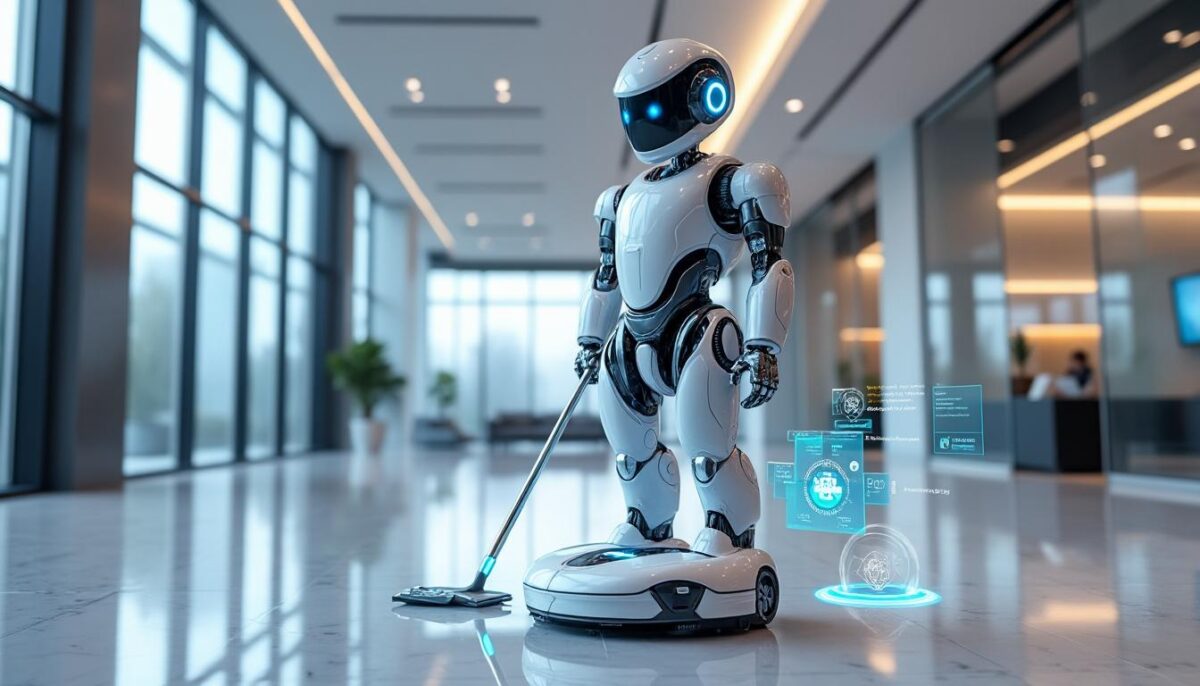
In brief — key takeaways
- 🔎 Agentic AI is enabling autonomous cleaning workflows that act with intent and accountability.
- 🤖 Physical AI (robots, robovacs, humanoid assistants) is the most visible shift in cleaning automation.
- 🧠 Domain-specific AI and synthetic data are powering safer, compliant facility management models.
- 🔐 Privacy and sovereign AI drive on-device processing in regulated environments.
- 💡 Smart janitorial solutions will combine wearables, pins, and ambient assistants for real-time insights.
- 📈 Adoption strategy: pilot hybrid human-agent teams, instrument KPIs, then scale.
Agentic Janitor AI: How Autonomous Agents Transform Facility Management
Agentic AI refers to systems that sense, decide, and take sequences of actions autonomously. In facility management, this means agents that schedule routes, respond to incidents, and coordinate human crews with robotic counterparts.
From rule-based rotas to autonomous decision-making
Traditionally, janitorial operations followed fixed schedules and manual checklists. Agentic janitor AI converts those schedules into dynamic policies: an agent monitors sensor feeds, occupancy data, and sanitation alerts, then reroutes robots or dispatches staff automatically. For example, a sports arena that once cleaned only during nightly windows can now have agents that initiate targeted cleans between events, based on predictive crowd-flow models. This reduces downtime and ensures higher hygiene standards.
Practical implementation: the CleaTech pilot
Consider CleaTech, a fictional startup led by Maya Chen. CleaTech deployed a hybrid agent platform integrating open-source frameworks and a domain model tuned to cleaning tasks. Agents analyzed floor cameras, IoT mop sensors, and waste-bin fill levels to prioritize cleaning. Within three months, CleaTech cut response time to spills by 60% and reduced overtime by 25%.
Ethical guardrails and auditability
Enterprise clients demand transparency. Proactive teams embed audit logs into every agent action, showing decision rationales and sensor inputs. These traces help meet compliance requirements in healthcare and food services. As Gartner and other analysts project, around 40% of enterprise apps will include task-specific agents soon, so adding governance from the start is crucial.
Insight: Agentic janitor AI elevates facility management by turning reactive cleaning into orchestrated, accountable processes.

Physical AI and Robotic Cleaning: From Robovacs to Humanoid Assistants
Physical AI is the tangible outcome of AI research: robots, drones, and devices that physically interact with environments. At CES and in enterprise pilots, the most visible innovations were robovacs with advanced recognition and humanoid assistants designed for complex tasks like laundry and kitchen prep.
New form factors and capabilities
Robovacs such as the Narwal Flow 2 demonstrate advanced object recognition, enabling them to avoid toys or focus cleaning power in pet zones. The Roborock Saros Rover pushed boundaries further: a two-legged vacuum with foldable legs and wheels that can climb stairs — a breakthrough for multi-level facilities without installation of ramps or elevators for equipment.
Human-robot collaboration in real contexts
In a university setting, teams paired mop robots with janitorial crews. Robots handled routine floor maintenance and item recognition (reminding staff of misplaced property), while human workers managed deep cleans and delicate tasks. This pairing improved throughput and allowed staff to focus on tasks requiring judgment and empathy.
Safety and standards
Deployers prioritize safety-first certifications and ISO-compliant behavior. Robots must include haptic feedback, fail-safe stops, and clear human handover protocols. Emphasizing these elements reduces incidents and accelerates procurement approvals in public institutions.
Insight: Robotic cleaning brings measurable operational value when integrated as partners rather than replacements.
Ambient Intelligence and Wearables: Qira, Pins, Rings and On-Device Agents
Ambient intelligence is changing how cleaning teams interact with technology. Instead of separate apps, assistants like Lenovo Qira unify experiences across phones, wearables, and PCs to build a fused knowledge base that remembers preferences, documents, and prior tasks. This is ideal for janitorial teams who need context-aware instructions and hands-free access to schedules.
Wearables and passive capture
Devices like the Pebble Index ring and Project LUCI's pin convert immediate user intent into actionable items. Imagine a facilities manager pressing a ring to mark a spill; the ring sends a timestamped report, a nearby agent reroutes a robot, and the incident is logged for compliance. These small form factors reduce friction and speed response.
On-device privacy and continuous monitoring
Apps such as Thine propose always-on phone-based assistants that run in the background. For sensitive environments, on-device processing limits cloud exposure. Combining on-device inference with federated updates ensures model improvements without compromising tenant privacy.
Insight: Ambient intelligence and wearables create a seamless, privacy-aware layer that empowers janitorial teams to act faster and smarter.

Generative and Multimodal AI in Cleaning Automation Workflows
Multimodal AI fuses text, images, and video to provide richer situational awareness. In cleaning automation, this means agents that analyze CCTV, voice reports, and maintenance logs simultaneously to generate step-by-step corrective actions.
You might also like: Old Character AI Review Nostalgia Or Still Worth It
Use cases: incident triage and training
Take a shopping mall that receives a spill alert. A multimodal system ingests the camera clip, a staff voice note, and a sensor reading, then generates a precise cleanup plan, including chemicals to use, PPE recommendations, and estimated time. For training, simulated video scenarios created by generative models teach new hires how to handle hazardous material spills safely.
Creative ops: marketing and documentation
Facility managers can use generative video tools to create onboarding content and operational SOPs. This helps maintain consistent practices across distributed sites. Yet as synthetic media becomes mainstream, provenance and watermarking are essential to avoid misuse.
Insight: Multimodal AI reduces ambiguity and accelerates both response and learning in janitorial operations.
Synthetic Data and Domain-Specific Models for Safe, Accurate Cleaning AI
Public training datasets are reaching limits. For janitorial AI, synthetic data provides privacy-safe, diverse scenarios for model training. Synthetic datasets can simulate rare events like chemical spills or unusual floor contaminants, allowing models to learn without exposing customer data.
How synthetic data is applied
Finance and healthcare use synthetic data for stress-testing; similarly, facilities can use generated footage of spills, obstructions, and furniture layouts to enhance detection models. This reduces the need to collect and annotate dangerous or proprietary footage from live sites.
Domain-specific language models (DSLMs)
Vertical models specialized for facilities understand terminology, compliance needs, and equipment manuals. By 2026, many organizations adopt DSLMs tailored to janitorial vocabularies: chemical safety, certification codes, and vendor SLA terms. These models provide accurate recommendations while respecting regulations.
| Use Case ⚙️ | Benefit 📈 | AI Approach 🧠 |
|---|---|---|
| Spill detection 🧴 | Faster response ⏱️ | Multimodal vision + DSLM |
| Staff training 🎓 | Lower onboarding time ✅ | Generative video + synthetic scenarios |
| Compliance logging 📝 | Audit readiness 🔒 | Agentic logging + on-device processing |
Insight: Synthetic data and domain specialization yield robust models that respect privacy and regulatory constraints.

Sovereign AI, Privacy and On-Device Janitorial Solutions
Geopolitical shifts and data protection regulation push organizations toward sovereign AI and privacy-first architectures. For facility management, this translates into on-premise or edge deployments where sensitive camera footage and occupant data never leave a local network.
Why sovereignty matters for cleaning AI
Critical sites — hospitals, government facilities, and financial centers — require strict data residency. Running models on local servers or edge devices avoids cross-border data concerns and reduces latency for real-time responses. Vendors that offer EU-compliant stacks or localized inference gain large contracts.
Edge kits and productization
Startups can package on-device inference using NVIDIA Jetson or similar hardware, bundling software updates and remote management under robust SLAs. This approach appeals to buyers wary of cloud-only solutions and aligns with predictions that sovereign AI will grow rapidly.
Insight: Sovereign and privacy-focused deployments increase trust and enable mission-critical janitorial AI use cases.
As the demand for advanced AI companions grows, many users are exploring alternatives to character ai that offer unique features and enhanced interaction capabilities. Our expert picks for 2026 highlight some of the best platforms that not only rival Character AI in functionality but also provide innovative tools for creators and enthusiasts alike. Whether you're looking for more customization options, improved natural language processing, or diverse character libraries, these alternatives present exciting opportunities to enhance your AI experience.
Business Models, ROI and Workforce Transformation in Janitor AI
Beyond technology, companies must design sustainable business models and reskilling paths. Gartner and Deloitte forecast a shift toward AI-native development and smaller, highly-productive teams. For janitorial services, this means blending software subscriptions, hardware leases, and performance-based contracts.
Commercial models and KPIs
Operators often adopt models like “robot-as-a-service” or subscription bundles that include maintenance, data analytics, and continuous model updates. KPIs focus on response time, labor hours saved, incident recurrence, and tenant satisfaction. Real-world pilots show payback periods under two years when robots and agents reduce overtime and improve asset lifespan.
Workforce evolution and new roles
Jobs shift from routine cleaning to oversight, model auditing, and robot maintenance. Roles like "cleaning workflow designer" or "agent supervisor" provide career progressions, while training programs pivot to include ROS basics and prompt engineering. This transformation is an opportunity for staff to gain higher-value skills.
- 💼 Revenue: subscription + hardware leasing
- 📊 KPIs: response time, compliance rate, cost per cleaned square foot
- 🎓 Workforce: reskilling programs and certification pathways
Insight: Sustainable ROI comes from combining technology with human-centered reskilling and measurable KPIs.
{"@context":"https://schema.org","@type":"FAQPage","mainEntity":[{"@type":"Question","name":"How does Janitor AI improve response times in facilities?","acceptedAnswer":{"@type":"Answer","text":"Janitor AI uses agentic workflows and real-time sensing to prioritize incidents u2014 combining camera feeds, wearable inputs, and schedule data to dispatch robots or staff automatically. This reduces manual coordination and shortens response times significantly."}},{"@type":"Question","name":"Are robotic cleaners safe to deploy in public spaces?","acceptedAnswer":{"@type":"Answer","text":"Yes, when they adhere to safety standards and include human-override features. Vendors typically incorporate fail-safes, haptic feedback, and audit logs. Pilots in universities and airports show reduced injuries when robots collaborate with trained staff."}},{"@type":"Question","name":"What role does privacy play in cleaning automation?","acceptedAnswer":{"@type":"Answer","text":"Privacy is central. Sovereign and on-device models keep sensitive video and occupant data local, and synthetic data can be used for training to avoid exposing real footage. These practices facilitate deployments in regulated environments."}},{"@type":"Question","name":"Where can I learn alternatives to character-driven AI tools for roleplay and interactive demos?","acceptedAnswer":{"@type":"Answer","text":"For a curated list of character AI and related interactive platforms, consult <a href=\"}}]}How does Janitor AI improve response times in facilities?
Janitor AI uses agentic workflows and real-time sensing to prioritize incidents — combining camera feeds, wearable inputs, and schedule data to dispatch robots or staff automatically. This reduces manual coordination and shortens response times significantly.
Are robotic cleaners safe to deploy in public spaces?
Yes, when they adhere to safety standards and include human-override features. Vendors typically incorporate fail-safes, haptic feedback, and audit logs. Pilots in universities and airports show reduced injuries when robots collaborate with trained staff.
What role does privacy play in cleaning automation?
Privacy is central. Sovereign and on-device models keep sensitive video and occupant data local, and synthetic data can be used for training to avoid exposing real footage. These practices facilitate deployments in regulated environments.
Where can I learn alternatives to character-driven AI tools for roleplay and interactive demos?
For a curated list of character AI and related interactive platforms, consult <a href=
"I was skeptical at first, but Candy.ai genuinely surprised me. The conversations feel incredibly natural."
Ready to Meet Your AI Companion?
Join 2,000,000+ users already on Candy.ai. Start chatting in under 30 seconds.
Start Chatting Now — It's Free →
Create Your Perfect AI Girlfriend on Candy.ai
Chat, voice call, and generate images with the most realistic AI companion available. No credit card required.
Create Your AI Girlfriend Free →✓ Free forever plan ✓ No signup required ✓ NSFW enabled